A headshot is a small photograph doing a very large job. It stands in for you in places you will never be, and most people are still using one that stopped fitting a while ago. This guide covers what a professional headshot actually is, the kinds that exist, how a session runs, and how the pictures get used afterward.

A professional headshot is a photograph of your face and shoulders, made in controlled light and cropped so a stranger can read your expression at a very small size. Its job is to represent you where you are not: a profile, a firm bio, a conference program, a printed page.
What makes it professional is not the camera. It is that someone directs the light, the angle and your expression, retouches the file by hand, and delivers it in the sizes you actually need. That is the difference between a picture of your face and a photograph that works for you.
The frame is the simple part. A headshot is usually your head and shoulders, sometimes down to the waist, with your face large enough in the picture that it still reads when the whole thing is shrunk to the size of a thumbnail. Everything else in the frame is there to keep attention on your face, or it should not be in the frame at all.
The job is less obvious. Your headshot goes to meetings you do not attend. It sits beside your name on a profile someone opens late at night, on the slide that introduces you before you walk out, on the page a client studies while deciding whether to call. In all of those places the photo is quietly answering a question nobody says out loud: is this a person I would trust with this?
That is a great deal of weight for one small file, and it explains why a photograph made on purpose behaves so differently from a picture cropped out of something else. A real headshot is a decision. It tells people you thought about how you come across, which happens to be the exact thing they were trying to work out anyway.
Headshot is one word covering several different jobs. The differences are mostly about tone and use rather than equipment, and knowing which one you are after saves a lot of time in the planning call.
A quick way to decide is to name the single place the photo has to work hardest, then let that place set the rules. If the answer is a profile, crop tight and keep it warm. If the answer is a printed program, shoot a little wider so a designer has room to work. If the answer is a leadership page where your colleagues were photographed last year, match what they did. Everything else the session gives you sits on top of that one decision.
Most people need one session that produces two or three of these at once. That is the whole reason several looks are planned into a single sitting: the picture that suits a law firm bio is rarely the picture that suits a friendly post, and you should not have to pick. If you are not yet sure which one you are after, the headshots page shows what the range actually looks like.
Nothing about a session should be a surprise, so here is the shape of one.
We talk first. I want to know where the pictures are going, who will see them, and what you want a stranger to think when they land on your face. Then we plan your looks together, which is the wardrobe consultation, so you arrive with a plan instead of a bag of maybes.
Sessions happen in my private studio in Naples. No audience, no queue, nobody watching from a desk. I set the light, and then I direct you: chin, shoulders, hands, weight, the small angle changes that turn a braced expression into an easy one. That is guided posing, and it is in every session I shoot, because almost nobody walks in knowing what to do and almost everybody assumes they should. Clients drive in from around the region for exactly this, including clients who come down from Fort Myers, and the session runs the same way whatever the drive was.
You change, I reset the background, and we keep going. Several backgrounds and wardrobe changes in one sitting is the entire point: real variety out of one visit, rather than five near-identical frames of the same shirt.
If you would like hair and makeup handled before the shoot, I work with several professional stylists who can be arranged for it, for an added fee. Some people want that, and some would rather arrive ready.
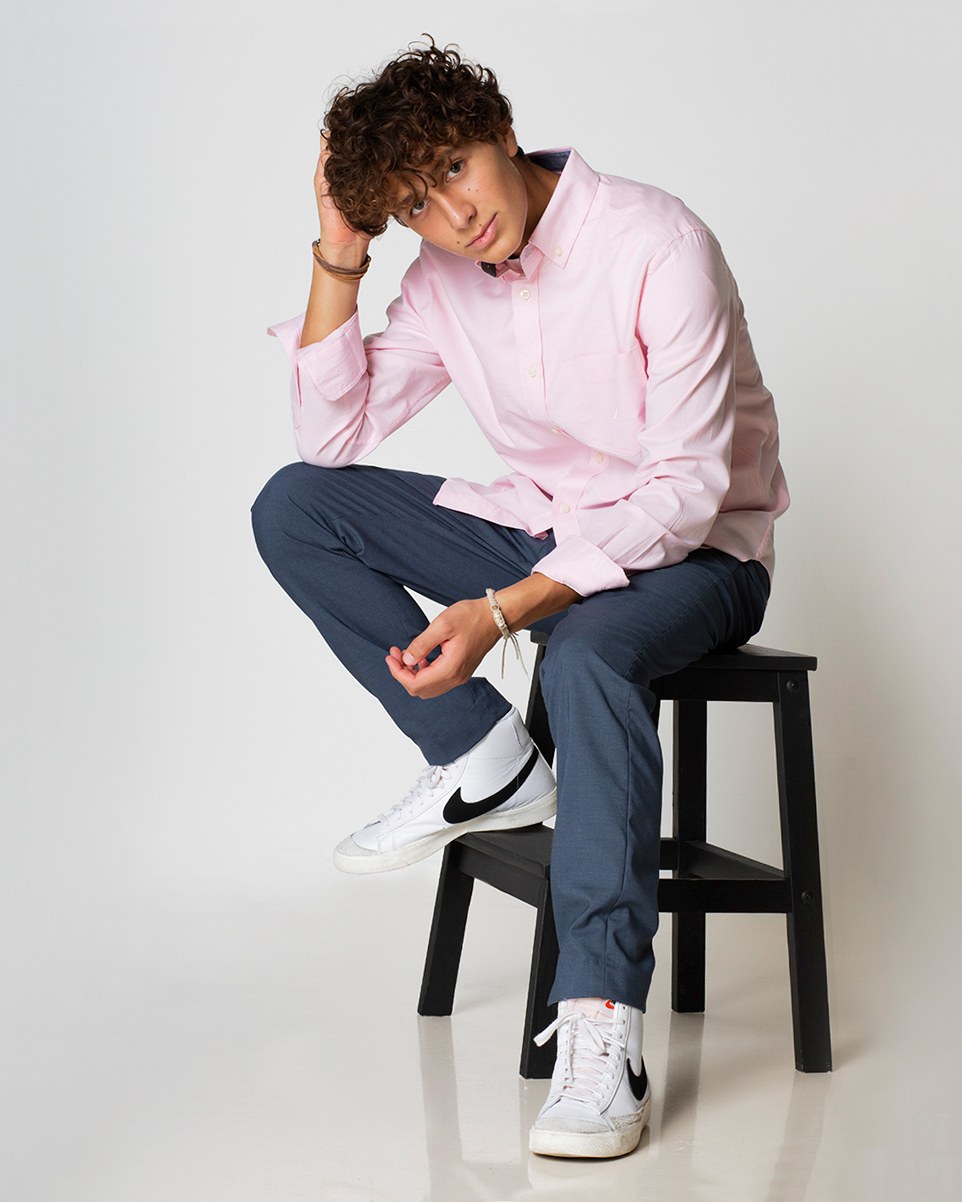
The clothes decision is the one people lose the most sleep over, and it is the one I most want to take off your plate. We settle it together on the call, before you pack anything.
The short version: bring a few options that fit properly, keep the colors simple, and let your face be the loudest thing in the frame. Everything past that, the necklines, the fabrics, the patterns that misbehave on a screen, the glasses question, the jewelry question, is laid out in what to wear for headshots. It is the guide I point people to before a sitting.
What I will add here is why the planning exists at all. A wardrobe consultation is not a style lecture. It is a scheduling decision. If we know your looks in advance, we can shoot all of them in one visit without burning the session on indecision, and you leave with a set that covers a formal bio, a warmer profile and something sensible in between.
The session is half the work. Editing is the other half, and it is where a professional file separates itself from a good snapshot.
I retouch by hand. That means a person looks at your face and makes small, considered decisions, rather than a filter flattening everything it does not understand. The aim is you on a good day, not a stranger with your haircut.
Your finished images arrive in a private, password-protected gallery within the week, ready to download and share. From there the practical part begins. The same photograph has to become a square for one profile, a circle for another, a tall crop for a program and a wider one for a banner. Files come formatted for LinkedIn, web and print, so you are not re-cropping your own face at midnight before a deadline.
Two practical things are worth asking any photographer for. First, a version with a little breathing room around your head alongside the tight crop, because banners, covers and print layouts all need space that a close crop has already thrown away. Second, files you can hand straight to somebody else, a designer, a conference organizer, whoever looks after your firm's website, without anybody needing a conversation about formats.
If you want your favorites to live somewhere other than a screen, custom albums, fine prints and gallery canvases are available too.
The craft does not change from one job to the next. What changes is the impression the picture has to make in the first half second.
For realtors, the photo functions as a logo. It rides on signs and postcards and has to be recognizable in person, which is the argument for a current picture over a flattering one. For attorneys, credibility comes first and warmth second, though second still matters, because people are usually frightened by the time they call a lawyer. Medical professionals need that order reversed: calm and approachable first, because the person looking is often anxious before the appointment even happens.
Leaders and founders need presence without severity, which is the whole balancing act behind executive headshots. Anyone whose next opportunity arrives as a message needs the version that survives a small circle, which is what LinkedIn headshots are for. Speakers, coaches and consultants tend to need the widest range, because their photo appears on programs, slides, posts and press pages that all want something slightly different.
None of this changes the session itself. It changes the plan we make beforehand: which look leads, how formal the wardrobe goes, whether the background stays neutral or picks up a little color. Say what you do on the call and I will build the sitting around it.
Phones take extraordinary pictures now, and it is a fair question why a session is still worth doing. The honest answer is that the camera was never the hard part.
A phone cannot direct you. It cannot see that you stopped breathing when the timer started, that the smile set a beat too early, or that the angle you picked is the one nobody looks good from. Those are decisions, made live, by someone watching you rather than watching a screen.
AI generated portraits have the same gap in a different costume. They can produce a smooth, plausible person in a jacket. What they cannot do is catch the specific moment you stopped bracing, because that moment has to happen in front of a lens. People are surprisingly good at sensing when a face has been assembled rather than photographed, and on a profile where the entire premise is trust, that instinct works against you.
A useful way to hold the difference: a snapshot records whatever your face happened to be doing. A headshot decides what your face is doing. If you want the mechanics of that decision, how to pose for photos takes it frame by frame.
Sometimes the honest answer is that a headshot will not solve the problem you have.
If you are posting several times a week, building a website, or pitching regularly, one face on a plain background runs out fast. What you need is a library: a range of looks, wider frames, images with room for words over them. That is personal brand photography, and it is a different session with a different plan behind it.
And sometimes the portrait has nothing to do with work at all. People book sessions simply because they want a photograph of themselves as they are right now, which is what boudoir photography is really about, including the quieter, fine art end of it. Different subject, same principle: you will be guided, and you will never be left to work out what to do with your hands.
You now know what a headshot is, which kind you probably need and what a sitting involves. What is left is the part specific to you: your looks, your uses, and what the investment should be, none of which belongs in a guide. Call me at (239) 319-6171 or send the form and we will plan it.
Book a Session Call (239) 319-6171Tell me a little about what you have in mind and I will be in touch personally. Pricing is personal, so the best way to plan is a quick call.
Share a few details and Annie will be in touch personally.