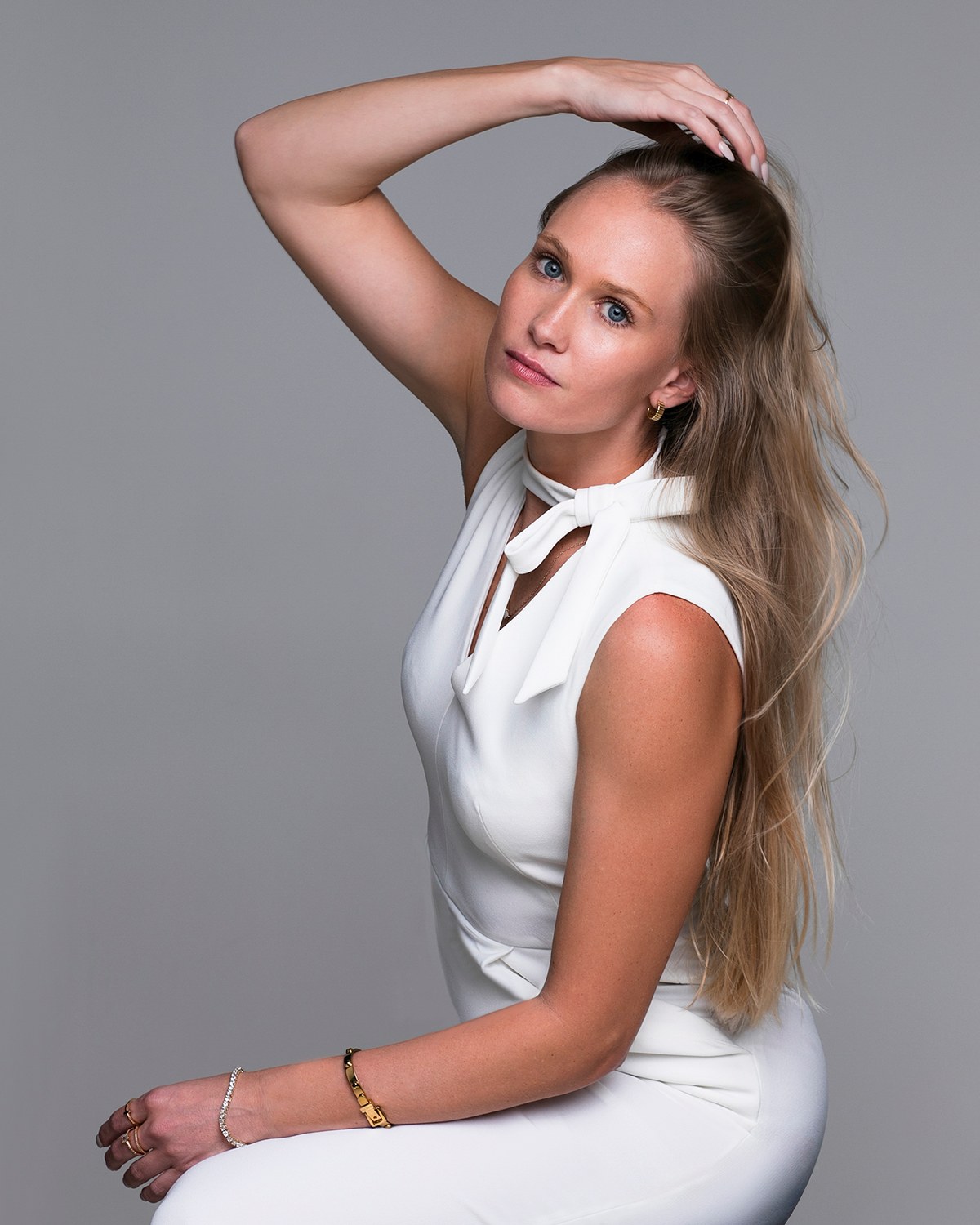
A camera does not measure you against a doorway. It measures you against the edges of the frame, and that is a problem you can solve with a few specific choices, not a wish. Camera height, the turn of your body and where the crop lands do almost all of the work. None of it changes who you are. It changes what the lens sees.

The camera reads length, not inches. Raise the camera slightly above eye level, turn your body so one shoulder leads and the spine reads as a diagonal line instead of a short vertical one, and choose a crop that includes the ankle or cuts above the knee rather than one that lands mid-shin. Stand more often than you sit, because standing gives the frame a longer line to work with.
Nothing here promises a number of inches. It is the same geometry I use with every client: camera angle, body line and crop decide how the frame reads, and those three things are entirely mine to direct.
Here is what actually happens in a bad photo of a petite client: the camera sits low, the body faces straight on, and the crop lands at an unlucky spot on the leg. Every one of those is a choice somebody made, usually by accident, and every one of them can be made differently. None of it is about how tall you are. It is about where the lens sits and where the frame cuts.
I bring this up first because most people who feel this way about photos have quietly decided the problem is them. It almost never is. It is a camera pointed straight on from too low, at a body standing square, cropped without a plan. Fix those three and the conversation about height stops coming up.
A lens positioned a little above eye level and angled down very slightly elongates everyone it points at. A lens below eye level, the classic angle from a phone held at waist height, does the opposite to every single person regardless of frame, and it is the single most common mistake in a self-shot photo. In my studio the camera sits at a height I choose for you specifically, and it rarely stays in one place for the whole sitting.
For a petite client I set it a touch higher than I would for someone with a longer torso, and I tip it down by a few degrees rather than shooting flat. That small downward angle lets the frame include more of the body above the horizon line of the shot, which reads as more room and more length. It is a two-second adjustment on my end and it changes the whole photograph before you have moved at all.
A body facing the camera square on reads as a rectangle: shoulders level, hips level, one straight vertical line from collar to hem. A body turned so the hips and shoulders sit at a slight angle to the lens reads as a diagonal, and a diagonal line always reads as longer than a vertical one of the same actual length. This is the same fundamental from my guide on how to pose for photos that I teach everyone, and it does more for a petite frame than any other single adjustment.
Stagger your feet, put weight on the back foot, and let the front knee soften. That stance alone stretches the visible line from shoulder to ankle without moving the camera or you gaining a fraction of an inch. Keep your chest open toward the light rather than folding it toward the far shoulder, because a body that curls inward shortens itself for the camera on top of everything else.
Where a photograph cuts your body matters more than most people expect. A crop that lands mid-calf or mid-shin interrupts the eye right where it wants to keep traveling, and it reads as shorter than a frame that either stops well above the knee or includes the full leg down to the shoe. There is no safe middle crop on a leg. Choose the top of the thigh for a three-quarter portrait, or go all the way to the floor.
I choose the crop before I choose the pose, because the crop sets the rules the pose has to work inside.
Standing gives a frame more vertical line to work with than sitting does, because a seated body folds its own length in half at the hip. For a petite client I lean on standing poses more than I would for someone with a longer frame, using the turn and the staggered stance from a section above. The full mechanics of a strong standing pose, weight, feet and the line of the spine, are covered in my standing posing guide, and it is worth reading if a standing full-length photo is part of what you need.
That does not mean sitting is off the table. A seated frame that leans forward from the hips, keeps the spine long and puts one foot slightly ahead of the other still reads well, and for a boardroom-style seated headshot the height question barely applies at all, since the crop stops at the chest. Choose standing when the whole body is in frame and the goal is length. Choose sitting when the frame is closer and the goal is presence.
In any full-length frame, the shoe is doing quiet work at the very bottom of the photograph, and it is one of the last things people think about while planning what to wear. A heel, or a shoe with any visible arch, extends the line of the leg in a way a flat sole does not, and a hem that sits at the ankle reads longer than one that stops mid-calf. None of this is a rule you have to memorize alone. It is exactly what my guide on why shoes matter in full-length portraits walks through in detail, and it pairs directly with everything in this section.
Wardrobe proportion follows the same logic. A single unbroken color from shoulder to shoe reads as one long line. A strong horizontal break, a contrasting belt, a cropped jacket at the hip, or a hem that lands at a different point than the shoe color, breaks that line into visible sections, and each section reads as its own separate length. Keep the breaks vertical where you can, a seam, a zipper, a row of buttons, rather than horizontal.
None of this requires you to think about it on the day. I set the camera height before you arrive at the mark, I choose the crop for each look before we start it, and I direct the turn and the stagger the same way I direct every client. You bring the wardrobe we planned together in advance, ideally in a single line from shoulder to shoe with shoes that have some lift to them, and I handle the geometry.
This is also where the difference between being posed once and being guided the whole time matters most. A pose set at the start of a look and then left alone drifts within a few frames, and a drifted stance undoes camera height and crop planning together. I keep adjusting through the whole sitting, which is the entire idea behind guided posing and the reason it is part of every session I shoot, whether it is headshots for a profile photo or a full personal brand library with a range of crops in it.
If a full-length photo is part of what you need, the shoe and the hem are the two choices that are yours, and they are worth settling in the wardrobe consultation before the day. The camera height and the crop are mine, and I set both before each look starts. Call (239) 319-6171 or send the form and tell me whether the pictures need to show the whole of you.
Book a Session Call (239) 319-6171Tell me a little about what you have in mind and I will be in touch personally. Pricing is personal, so the best way to plan is a quick call.
Share a few details and Annie will be in touch personally.