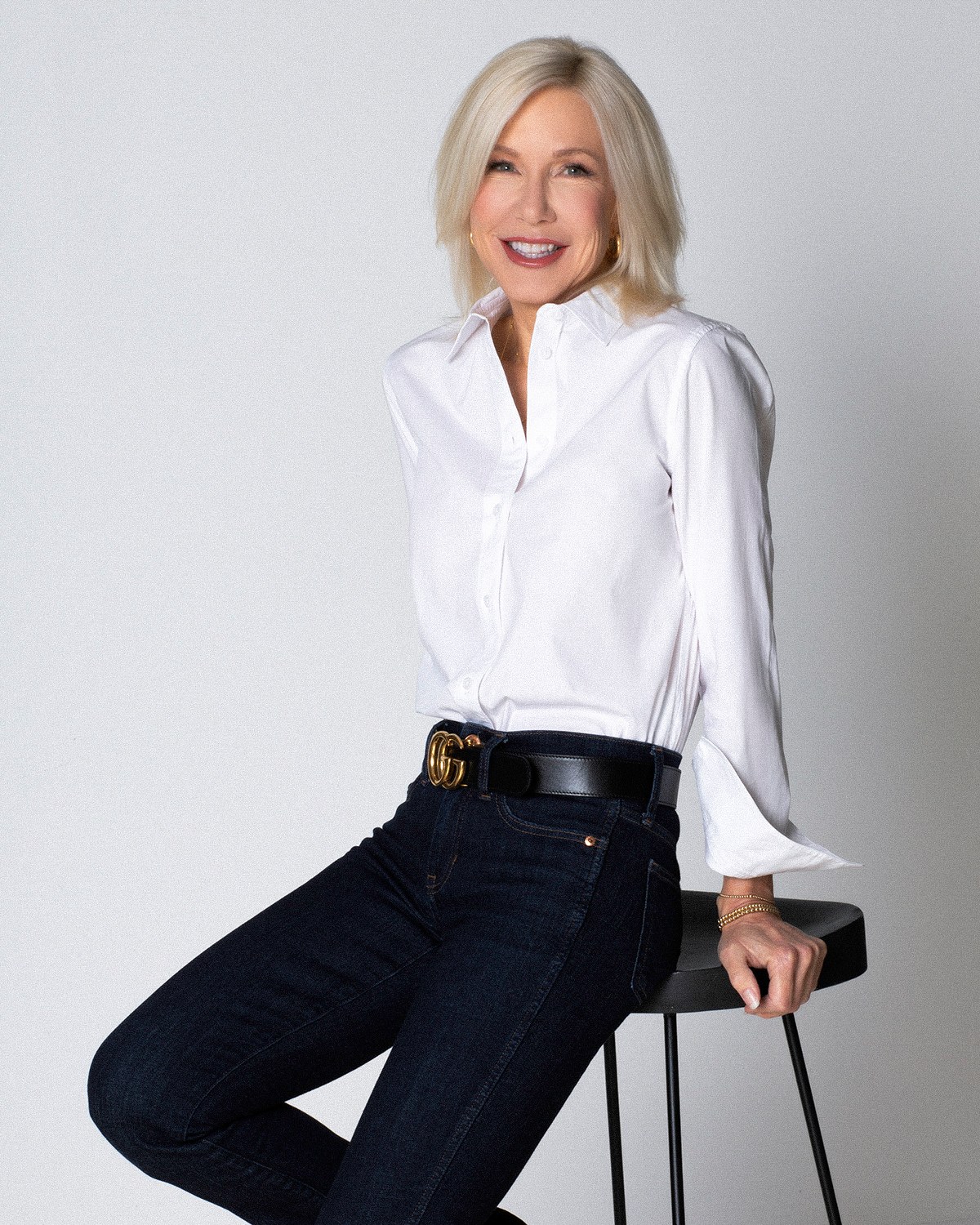
The worry is almost always the same one: that you will be stood in the middle of a room and expected to produce something. That is not what happens in a directed session, and the best preparation for your first sitting is simply knowing what the next few minutes are going to sound like. So here it is, in order.

You do not need to know how to pose for your first photoshoot. In a guided session the photographer gives you one small physical instruction at a time, watches what it did, and corrects it, so your job is to follow the last thing you were asked and nothing more.
What helps most is knowing the shape of it. The first frames are warm-up rather than pictures. The instructions are short and physical: turn, weight, shoulder, chin, breathe. You are allowed to forget each one the moment it is done, and you are allowed to say when something is not making sense.
There is a belief that being photographed is a skill you were supposed to have picked up somewhere, and that everyone else got the lesson. Nobody got the lesson. The people who look easy in pictures are, almost without exception, people who were directed well, and the difference between them and you is a photographer talking, not a talent you were born without.
So the honest answer to what you should learn before your first session is nothing. Not a set of poses, not a list of angles, not a smile rehearsed in a bathroom. Arriving with a plan usually makes things harder, because a rehearsed pose is a thing you are holding, and holding is exactly what a camera photographs.
What the method is, and why continuous direction works on people who dread this, is set out in guided posing. This page is narrower: what a first session feels like from your side of the camera, and what to do with the instructions when they start.
The shutter starts firing before anything is any good, and that is deliberate. I say so out loud while it is happening, because the alternative is you deciding privately that the session has already gone wrong.
Two things are happening in them. Your body is discovering that following an instruction is easy, which lowers the stakes considerably. And your face is running out of the particular tension people arrive with, which does not leave because someone tells you to relax. It leaves because you got busy doing something else.
Nobody's first frame is their best one, whatever they walked in believing about themselves. The picture you will actually use comes later, usually somewhere after the point where you stop narrating your own performance in your head.
Direction in a portrait sitting is a short, repeating vocabulary. Reading it once now means it will sound familiar rather than strange when it starts.
That is most of it. The whole vocabulary is physical, which is the point: you are being asked to move something, never to feel something. The mechanics underneath each of those cues, and why they work, are explained in how to pose for photos if you would like the reasoning as well as the instruction.
Say so. That is the entire answer, and it is worth hearing before the day, because the instinct of a polite person is to nod and guess.
Vocabulary is personal. Long through the spine means something instantly to one person and nothing at all to the next, who needs grow an inch or imagine a string at the crown of your head. If a word is not landing, I will find a different one, and occasionally I will just show you rather than describe it. None of that is a setback; it is how the direction gets calibrated to you.
Two other things worth knowing. If you are given a correction, it replaces the last one rather than stacking on top of it, so you are never running six rules at once. And if you drift back, which everyone does, you will simply be told again. Being told the same thing three times is not a failure. It is what continuous direction looks like from the inside.
Nervousness has a shape, and it is useful to recognize it, because seeing it coming takes away most of its power.
Each of those has a one-second counter-move, and each of those counter-moves is an instruction you will simply be given, so there is nothing to memorize. Breathe out. Shoulders down. Soften the knees. Hand on the jacket. Chin forward and down. Lips slightly apart.
The nerves themselves, where they come from and what actually reduces them, deserve more room than this page can give and have their own guide in camera anxiety. The short version for a first-timer is that a body with a job to do has very little attention spare for watching itself.
Something reliable happens partway through a first session, and it is worth expecting so you do not mistake the early part for the whole of it.
By the time you change into the second look, the cues have become familiar. You already know what chin forward means in your own neck, so it stops being a translation exercise and becomes a movement. The room has stopped being unfamiliar. Nothing has gone wrong, which quietly removes the fear that something was about to.
A change of clothes helps as well, because it interrupts the momentum of whatever you were doing and resets the direction with it. Several looks in one sitting is partly about variety and partly about this: the second and third looks tend to be looser than the first, and knowing that in advance takes the weight off the opening frames.
That is also why an unhurried pace matters more than anything technical in the room. If a look is not working, we change it. If you need a minute, you take a minute. There is nothing you can fall behind.
You need nothing, and there are two things that make the day feel more familiar if you would like something to do.
The first is a few minutes at a mirror, learning the feel of two or three adjustments rather than rehearsing poses: the chin move, the weight shift, the shoulder drop. The distinction matters. Learning the feel makes direction land faster. Rehearsing a routine makes you rigid and puts you in an argument with the person directing. A sensible version of it is laid out in this mirror practice routine.
The second is the practical part, which is genuinely worth more than the posing part: what to bring, what to steam, what to sleep on. All of it is a countdown rather than a skill, and it is written out in how to prepare for a photoshoot.
Beyond that, arrive calm and arrive uninformed. Every one of the headshots sittings I photograph starts from the same assumption, that the person in front of me has never done this and needs to know nothing, because that is the ordinary case rather than the exception.
If you have been putting this off because you do not know what you would do in front of a camera, that is the part you are not required to solve. Come and be told, one small instruction at a time, in a private Naples studio where the only other person in the room is me. Planning and pricing are personal, so call me at (239) 319-6171 or send the form.
Book a Session Call (239) 319-6171Tell me a little about what you have in mind and I will be in touch personally. Pricing is personal, so the best way to plan is a quick call.
Share a few details and Annie will be in touch personally.