Portfolio
Headshots Boudoir Personal Brand
More
Guides Investment Guided Posing About Book a Session
Home  /  Guides  /  Seated Posing Guide
Posing

Seated posing, done properly.

A seat looks like the easy part of a portrait and behaves like a trap. It invites your spine to fold, your knees to point wherever they land and your hands to disappear into your lap. Here is how to sit for a camera on purpose, from the edge of the seat to the last inch of the lean.

By Annie Watson · Naples, Florida · Updated September 2026
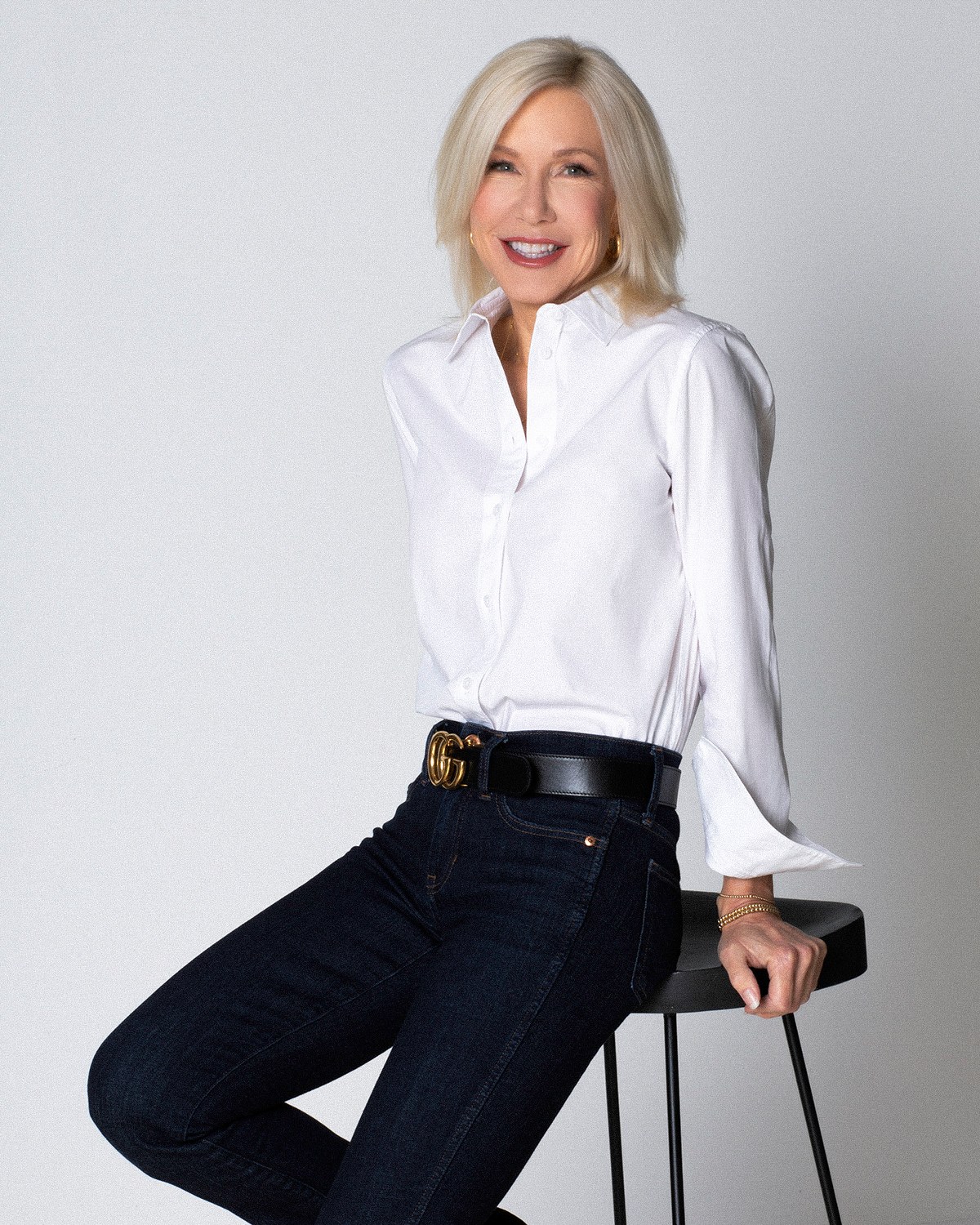
Woman with blonde hair in a white blouse and dark jeans, seated on a stool, light backdrop, photographed by Annie Watson in her Naples studio
The Short Answer

Seated posing starts by taking the work back from the seat. Land on the front third of it so your own spine is holding you up, then tip the whole torso forward from the hip joint, keeping the back straight rather than letting it round. Both feet stay on the floor, the knees turn a few degrees off square to the camera, and each hand gets a specific place to be.

Everything else in a seated frame is a variation on those two decisions, where you sit and how far you tip. Get them right and the leg position barely matters. Get them wrong and no arrangement of legs, hands or chin will rescue the frame.

Start at the edge, not the back.

The first decision in any seated pose happens before the camera is even ready: where on the seat you land. Settling all the way back is the natural instinct and the wrong one, because a seat is built to support your weight, and the moment it does, your spine gives up the work of holding itself up. Sit on the front third instead, so your own back is doing the holding, not the furniture underneath it.

This one change does more for a seated portrait than any instruction that follows it. Sitting forward keeps the hips higher relative to the knees, which straightens the line of the torso instead of letting it fold at the waist. It also puts you in charge of your own posture instead of handing that job to whatever you happen to be sitting on.

The lean carries the rest of the pose.

Once you are sitting forward, lean toward the camera from the hips, not the neck. The lean should feel like the top half of your body is reaching slightly toward the lens while the lower half stays anchored. It is the same closer-to-the-lens rule the standing lean uses, applied from a hip joint that is now bent.

Watch the line between a lean and a slump. A true lean keeps the spine straight and simply tips it forward as a whole unit from the hip joint. A slump rounds the upper back and drops the chin, which undoes everything the lean was supposed to accomplish. If your shoulders round forward while you lean, you have gone too far or leaned from the wrong place.

Full posture mechanics, the spine and shoulder work that applies whether you are seated or standing, are covered in more depth on my posture in portraits page. This page picks up specifically where a seat changes those rules.

Feet, knees and the angle of the legs.

Plant both feet on the floor rather than tucking them under a seat or crossing at the ankle by default, and turn your knees a few degrees away from square to the camera. A body seated dead-on to the lens widens in exactly the way a body standing dead-on does, for the same reason: nothing about the frame is reading as a line.

  • Crossing at the knee works well and reads relaxed, as long as the top leg angles slightly away from the camera rather than pointing straight at it.
  • Crossing at the ankle, feet tucked slightly to one side, is a softer option that suits a quieter portrait.
  • Feet flat and hip-width apart, knees turned a touch to one side, works best for a full-length seated frame where the whole leg is visible.
  • Whatever you choose, avoid knees spread wide and square to the lens. It reads as sprawled rather than relaxed in almost every context.

None of these are rules to memorize in advance. In a session I choose the leg position based on the crop, the outfit and what the hips are doing, and I will move you between two or three of them across a sitting. If you want the wider set of mechanics this page builds on, from the feet up, my page on how to pose for photos covers the whole body, standing and seated.

Give your hands somewhere to land.

A lap with nothing in it becomes a problem within about four seconds. Hands left to their own devices clasp too tightly, disappear between the knees or press flat against the thighs, and all three read as nervous. Give them a specific task instead: rest one hand on the opposite forearm, let one hand rest along the thigh with the fingers slightly curled, or hold something that belongs in the frame.

The same rule that applies standing applies here: keep a visible gap between your upper arm and your ribs rather than pinning the elbow to your side. Seated, that gap is easy to lose because the arm naturally wants to rest straight down against the body. A small outward angle at the elbow keeps the arm from reading as pressed flat.

Wrists matter more seated than standing, because a resting hand tends to bend hard at the wrist under its own weight, so keep a soft break there rather than a right angle. What the hand itself does once it lands, fingers, edge, grip, is worked out position by position in what to do with your hands.

The collapse to watch for.

There is one seated mistake that undoes every other correct choice, and it happens gradually rather than all at once: the slow settle backward as a sitting continues. It starts in the shoulders, which round forward first. Then the chin drops with them, then the whole spine curves into whatever you are sitting on, and a little way into a look you are visibly lower and smaller than you were in the first frame.

It happens to almost everyone, because sitting still for any length of time is tiring in a way standing is not, and the body looks for the easiest way to rest. The fix is not willpower. It is a reset: re-sit toward the front of the seat, re-lengthen the spine, and re-find the lean every few minutes rather than trying to hold one position indefinitely.

In a directed session that reset is what I watch for, and it gets called out loud before the collapse shows up in a frame. On your own, build the habit of checking in with your own spine every so often rather than assuming the first good position will hold itself.

Seated poses that work for a purpose.

A seated pose has to be chosen for what the photograph is for, not for what feels comfortable. A tight crop that ends at the shoulders, the usual headshots frame, shows almost none of the seat, so the whole job is the upright spine and a small lean toward the lens; the legs could be doing nearly anything. A seated executive portrait keeps that uprightness but lets the body settle, and the specifics of that version are in how to pose for executive portraits.

The seated frame in a personal brand library is there for contrast with the standing and working frames around it, which is permission to loosen it: turned a little to the side, one arm resting casually, a more relaxed leg line. Repeating one ideal seated pose across a library defeats the reason for including it.

When standing serves you better instead.

Seated poses are not always the right call. A full-length frame, a portrait meant to show height or presence, or a picture that needs to convey energy usually works better standing, where the whole line of the body is visible and available. Sitting compresses a frame and suits a calmer, steadier mood, which is exactly why using both across a sitting produces a set of images that feel like a real range rather than one pose photographed repeatedly.

If a standing pose is what a particular photo actually calls for, the mechanics live on my standing posing page, including where the weight goes and how to avoid the stiff, feet-together stance that a seat, oddly, never produces but standing does. Leaning on a wall, or on a backdrop edge, is its own category again, closer to standing than sitting, and it has its own rules on my leaning poses page.

Key Takeaways
  • Sit on the front third of whatever you are sitting on. Settling back hands your posture over to the furniture instead of your own spine.
  • Lean forward from the hips, not the neck, and stop the lean before the upper back starts to round.
  • Turn the knees a few degrees away from square to the camera rather than facing the lens directly.
  • Give your hands a specific place to rest. An empty lap becomes a problem within seconds.
  • Watch for the slow backward collapse that a seat produces over time, and reset your spine and lean every few minutes.
  • A seated frame and a standing frame read differently on purpose, so use both across a sitting rather than choosing one for the whole session.
  • The full posture mechanics behind the seated lean, the spine and the shoulders, are covered on my posture in portraits page if you want the deeper version.
Next Step

The seat does not get the last word.

Every seated look starts on the front of the seat and slides backward from there, and nobody notices it from the inside. That slide is what I watch for across a sitting, and the reset happens before it reaches a frame. Pricing and planning are personal, so call (239) 319-6171 or send the form to talk through your session.

Book a Session Call (239) 319-6171
Put It to Work

Sessions this guide points to.

Good to Know

Questions, answered.

Is it better to sit with legs crossed or feet flat on the floor?
Neither is universally better. Crossed legs with the top leg angled away from the camera reads relaxed and suits a quieter portrait. Feet flat and hip-width apart, knees turned slightly, suits a full-length seated frame or a look that needs more energy. What matters more than the choice itself is avoiding knees spread wide and square to the lens, which reads sprawled in almost any context.
Why do I look shorter and heavier in seated photos than standing ones?
Because sitting compresses the torso by default, and settling back into a seat compounds it by letting the spine curve. Sitting on the front third of the seat and leaning forward from the hips restores most of that length. The length the camera reads when you stand is not gone when you sit; it is hidden by a posture the seat encourages if nobody corrects it.
Does the height of the seat matter?
More than most people expect. A low seat pushes the knees above the hips, which folds the torso at the waist before you have done anything, and it makes the forward lean harder to hold without rounding. A seat that keeps the hips level with or slightly above the knees gives the spine a straight base to work from. If the only seat is a low one, sit further forward on it, so the knees drop and the hips come up.
How do I keep from slumping the longer I sit for photos?
Treat it as a reset, not a hold. Every few minutes, sit forward again, re-lengthen the spine and re-find the lean, rather than trying to freeze one position for the whole look. The slump happens gradually because sitting still is tiring, and the fix is checking in periodically rather than willing yourself not to move at all.
Do I need different seated poses for a headshot versus a full-length portrait?
Yes, and the crop decides most of it. A headshot crop rarely shows past the shoulders, so a tight, upright seated posture with a small forward lean does almost all the work. A full-length seated portrait shows the legs and the whole line of the body, so leg angle and foot position matter as much as the spine and the lean do.
Is a seated pose ever the wrong choice?
It is the wrong choice whenever the photo needs to show height, energy or the full line of a body, since sitting compresses all three by nature. A seated frame suits a calmer, steadier mood, which is exactly why a good session mixes seated and standing looks rather than relying on one for everything. My standing posing guide covers when standing is the better call.
Book Your Session

Your best headshot is one session away.

Tell me a little about what you have in mind and I will be in touch personally. Pricing is personal, so the best way to plan is a quick call.

Studio
5400 Yahl St, Naples FL

Prefer to talk? Call (239) 319-6171. I respond personally.