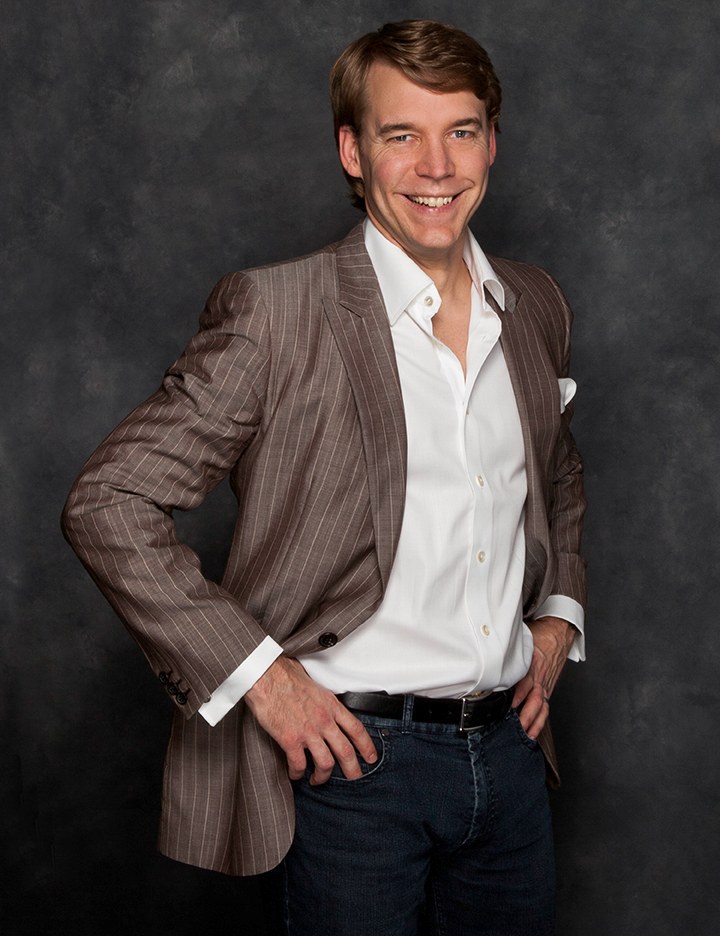
Posture is the frame the rest of a portrait hangs on. Before anyone thinks about the face, the camera has already read the spine, the shoulders and which way the weight is sitting. Here is how to build that frame on purpose, whether you are standing, sitting or just trying to stop slouching in a mirror tonight.

Good posture for a portrait is a long spine without stiffness: crown lifted, shoulders rolled up and released so they drop rather than hunch, and ribs held in rather than flared. Weight sits mostly on one leg or one hip instead of even on both, and the whole upper body leans a few degrees toward the camera rather than pulling back from it.
None of that is held rigidly. A portrait wants tall and settled at the same time, the way a person stands when they are paying attention to something rather than bracing for an exam. The lean is small: an inch, not a lunge, from the waist or the hip, never from the neck alone.
A slouched spine reads as tired even on a rested face, because the camera cannot see how you feel, only how you are arranged. Lengthen from the crown of the head as though a string ran straight up from it, and let your ribs settle down rather than jutting forward. That single adjustment does more for a portrait than almost any other single instruction I give.
Length is not the same as rigidity, which is the mistake that follows right behind slouching. Pull the spine too straight and the whole body reads braced, arms pinned, chest puffed like a photograph for a uniform. The target is tall and loose in the same body: think of someone standing to greet a friend, not someone called to attention.
Check it against a wall if you want a reference, not to stand pressed against it for the photo, just to feel where tall actually is. Most people carry their true height a little lower than they think, rounded forward at the top of the back from years at a desk or a phone. Finding it once in private makes it much easier to find again on demand.
Shoulders are where nerves show up first and most honestly. A held breath, a nervous laugh, an unfamiliar room, all of it collects at the top of the shoulders and pulls them toward the ears before you notice it happening. The camera notices immediately, and then notices again ten frames later, because shoulders do not stay where you put them once your attention moves on to something else.
Down and back are two separate instructions, and doing the second without the first is the usual overcorrection. Down is a release: let the arms hang their own weight off the joint instead of holding the joint up. Back is a small rotation on top of that release, far enough to open the chest without pushing it forward, and no further. Back without down produces the braced, chest-out stance that photographs as a position being held rather than a person standing.
The reset between frames is a breath out rather than a fresh shrug, since a shrug lifts the shoulders again before it drops them and an exhale simply lets them go. One more detail once your body is turned: the shoulder nearer the lens can sit a fraction lower than the far one, and a fraction is the whole instruction. Pushed further it stops reading as ease and starts pulling the head into a tilt nobody asked for.
Standing with weight evenly split on both feet is the most common posture mistake there is, because it feels stable and reads as stiff. Shift most of your weight onto one leg, usually the one set slightly back, and let the other soften at the knee. The hip on the weighted side rises a little, the line of the body curves instead of squaring off, and the silhouette reads narrower to the lens. The full mechanics of building that standing line, from the feet up, live on my standing posing page.
Wherever the weight ends up, the goal is asymmetry with a reason behind it. A body with its weight parked somewhere specific looks like it is choosing to be there. A body with weight split perfectly down the middle looks like it is waiting for something else to happen.
Once the spine is long and the weight has somewhere to go, add a small lean toward the lens, from the hips or the waist rather than the neck. Whatever sits closest to the lens takes up more of the frame, which is the whole, unglamorous reason the old advice to lean in works. The camera is not reading confidence. It is reading distance.
The lean has a limit. An inch or two changes the picture. Past that, the spine starts to curve and the whole line collapses forward, which undoes the length you just built. Practice it slowly in a mirror, watching the point where the lean stops feeling like posture and starts feeling like falling, and stay well short of it.
A forward lean also pulls the chin toward the camera, which pairs naturally with the chin-forward, chin-down adjustment that keeps the underside of the jaw from reading straight into the lens. The two moves reinforce each other, so once you find one, the other tends to follow.
A seat is built to take the work off your spine, which is useful everywhere except in front of a camera. The instinct to settle back against it is exactly the instinct to fight. Keep the weight forward through the hips and let the same long spine you built standing carry over into the seated version.
Crossed legs, uncrossed, ankles together, it matters far less than what the spine is doing above the hips. A person can sit in almost any leg position and still look composed if the length through the back holds, and can sit in the most careful leg position imaginable and still look collapsed if the shoulders have rounded forward.
That is as far as this page takes sitting. Where on the seat to land, what the legs and hands do, and the slow collapse a seat produces over a look are the whole subject of my seated posing guide.
Confidence in a photograph is not an expression on the face. It is almost entirely a story told by the spine, the shoulders and where the weight sits, and the face is simply where a viewer's eye lands last to confirm what the body already said. A long spine with settled shoulders reads as someone comfortable in the space. A collapsed spine with raised shoulders reads as someone who would rather be somewhere else, regardless of what the mouth is doing.
That is useful information, because it means posture is fixable in a way that feelings often are not. You do not have to feel confident to build a spine that reads as confident. You have to know where your crown, your shoulders and your weight are supposed to be, and put them there on purpose.
This is also why executive headshots lean so heavily on posture over expression. A leader's photo has to read as capable at a glance, and the line of the body is what a glance takes in first. Posture also decides whether a specific pose reads as confident or off: a hand resting on a hip, for example, only works once the spine and shoulders are set up first, which is the whole subject of my page on hands on hips.
Posture is not a pose you hold for one frame. It is the baseline you return to between every change of expression, angle and outfit across a sitting, which is why I check it constantly rather than once at the start. A spine that was long in the first frame tends to soften by the tenth unless somebody is watching for it, simply because holding anything for a while is tiring.
That is the entire case for direction over instructions read in advance. You can practice the crown lift, the shoulder roll and the small lean in a mirror tonight, and you should, because it will make the words familiar. But maintaining all three at once, across dozens of frames, while also managing an expression, is a lot to run in your own head. Somebody watching the frame and calling the small corrections is what keeps the posture from drifting once the nerves and the fatigue set in.
That is what how to pose for photos is built around, and it is the same idea behind every session I shoot, whether the result is a set of headshots or something else entirely. It matters even in a single cropped frame: how to pose for LinkedIn headshots comes down almost entirely to posture, since the crop leaves the camera nothing else to read.
The crown lift, the shoulder release and the small lean are three things to run at once, inside your own body, while also holding an expression. That is one too many, which is why they get called out loud from behind the camera instead. Pricing and planning are personal, so call (239) 319-6171 or send the form, and we can plan your looks from there.
Book a Session Call (239) 319-6171Tell me a little about what you have in mind and I will be in touch personally. Pricing is personal, so the best way to plan is a quick call.
Share a few details and Annie will be in touch personally.