Portfolio
Headshots Boudoir Personal Brand
More
Guides Investment Guided Posing About Book a Session
Home  /  Guides  /  Hands on Hips
Posing

Hands on hips when it works.

One hand on a hip is either the most confident thing in the frame or the most dated, and the difference is a handful of small mechanics: one hand or two, where the thumb sits, how bent the elbow is, and how much weight is actually behind it. It is worth examining closely, because it is one of the poses people most want to get right, and one of the most often done wrong without someone watching the frame.

By Annie Watson · Naples, Florida · Updated September 2026
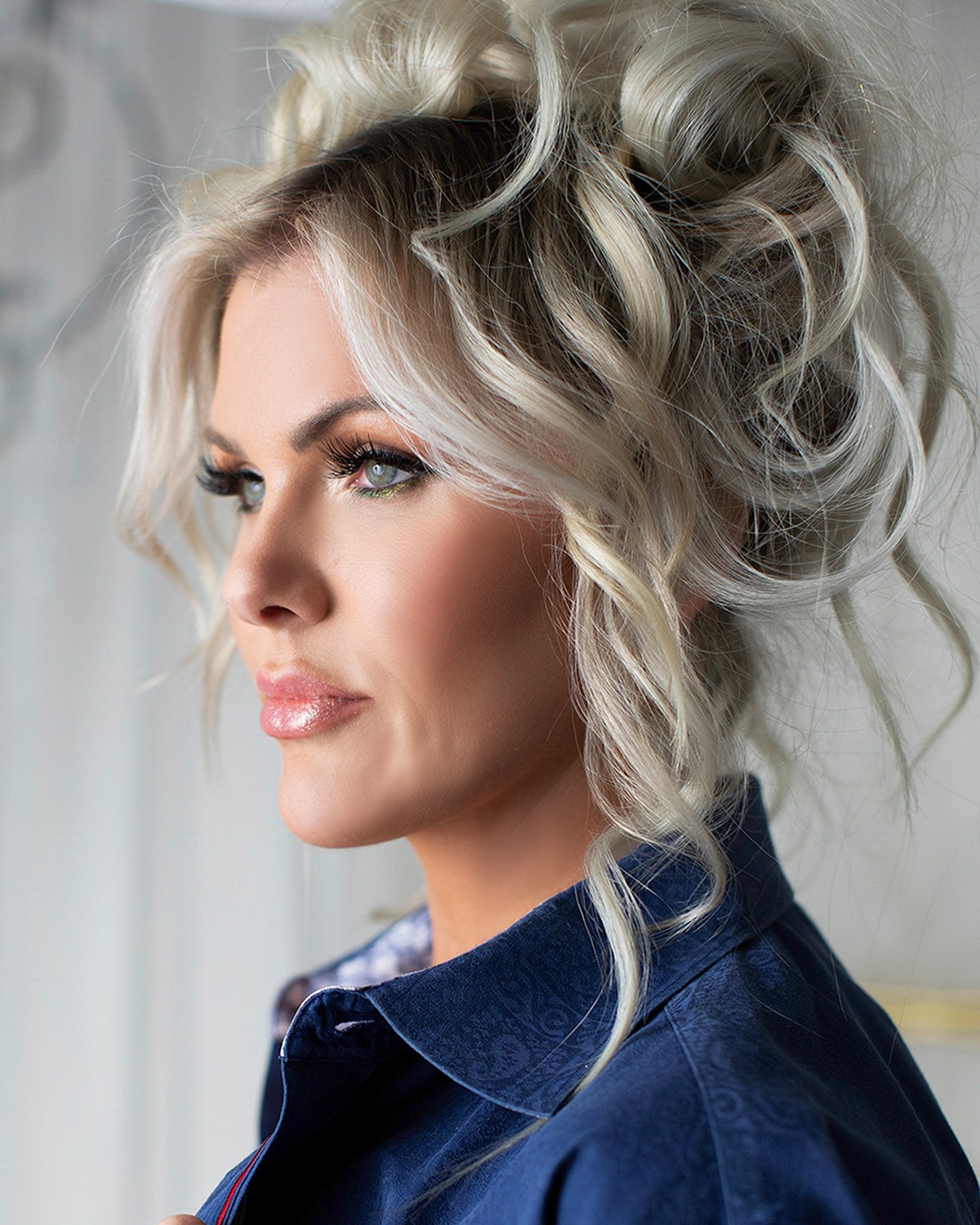
Woman with a blonde updo in a blue top, in profile with eyes closed, soft light, photographed by Annie Watson in her Naples studio
The Short Answer

A hand on a hip reads as confident when only one hand is used, the elbow bends out at a real angle rather than sitting flat against the ribs, and the weight has genuinely shifted onto the opposite leg so the pose has something to lean against. It reads as dated or stiff, sometimes called a pageant pose, when both hands are on the hips at once, the elbows are locked wide and symmetrical, and the body is squared flat to the camera underneath it.

The pose is not good or bad on its own. It is a specific arrangement of an elbow, a thumb and a weight shift, and each of those three has a version that works and a version that does not.

One hand, almost always.

Two hands on two hips, symmetrical, reads as staged before the viewer even processes why. It is the shape of a pose held for a camera rather than a moment caught mid-conversation, and it puts equal weight and equal tension on both sides of the body at once, which drains the line out of the frame rather than giving it one. One hand on one hip does the opposite. The other arm can hang, rest on something, or bend into a second gesture, and that asymmetry is what makes a pose look like a person instead of a diagram.

There is a narrow exception. A fully squared, two-handed hips pose can work for a deliberately bold, editorial brand image where the point is exactly that graphic, confrontational symmetry. It is a choice for a specific kind of frame, not a default, and I use it rarely and on purpose rather than as a fallback.

The elbow angle carries the whole pose.

A hand resting on the hip with the elbow tucked in close to the ribs looks tentative, almost apologetic, as if the gesture is being taken back as soon as it is made. The same hand with the elbow angled out, thirty to forty five degrees from the body, reads as deliberate. That gap between elbow and ribs is the same daylight principle behind every arm placement I teach: a visible space between an arm and the torso keeps both from reading as wider or more compressed than they are.

Push the angle too far and the pose starts to look like a teapot handle, exaggerated and self-conscious. The workable range is narrower than people expect, usually somewhere between a slight bend and a comfortable forty five degrees, and it is among the quickest corrections to make from behind the camera, because it is visible immediately in the frame.

Thumb forward or thumb back.

Where the thumb sits changes the read more than people expect from something so small. A thumb resting forward, toward the front of the hip, with the fingers wrapping back, reads as relaxed and current. A thumb pushed back toward the spine, fingers pointing forward along the hip bone, is the classic pageant placement and reads immediately as posed, largely because it is a hand shape almost nobody uses outside of being told to.

  • Thumb forward, fingers back along the hip: the modern, relaxed version.
  • Thumb back, fingers forward: the dated, pageant-adjacent version, worth avoiding by default.
  • A loosely curled hand, not flat and not clenched, reads better than a rigid flat palm either way.
  • The hand should rest on the hip, not grip it. Visible tension in the fingers reads through to the whole arm.

Weight has to actually shift.

The pose fails most often not at the hand but at the hips underneath it. A hand placed on a hip while the weight sits evenly on both feet looks decorative, like a prop rather than a gesture the body is actually doing. Shift real weight onto the leg opposite the hand on the hip, let that hip drop and the opposite one rise slightly, and the pose suddenly has a foundation instead of floating on top of a square stance.

That weight shift is the same mechanic behind almost every strong standing pose I direct, turning the feet, staggering the stance, committing to one side, the same fundamentals covered in how to pose. A hand on a hip is really a hand resting on top of a stance that was already correct. Get the stance right first and the hand placement becomes the easy part.

Who it suits, and when to skip it.

This is a pose about attitude and occasion, not about who is allowed to use it. It suits a frame that wants to read as assured and a little bit bold: a personal brand image for someone whose work is decisive by nature, a standing full-length shot that needs a strong silhouette, a moment in a session where the tone shifts from quiet to confident on purpose. It is a good pose to use once or twice in a sitting for variety, not one to repeat across every look.

It is the wrong choice for a tight, formal headshots crop where the frame stops above the waist and the hips never appear, and it can read as too aggressive for a soft, approachable brand tone where the goal is warmth rather than command. In the crop I describe in how to pose for LinkedIn headshots specifically, the hand placement almost never enters the frame at all, which makes the whole question moot for that particular shot.

What to try instead.

If a hand on the hip is not landing for a particular look, the alternatives usually solve the same underlying need, which is giving a floating hand somewhere purposeful to go. A hand in a pocket with the thumb outside does the same job with a quieter attitude. A hand resting on the opposite forearm reads as thoughtful rather than bold. Holding the edge of a jacket, a bag strap, or the back of a chair gives the hand an object instead of a hip, which can be easier to hold naturally for several frames in a row.

The full range of where hands go when there is nothing to hold and no hip in reach is worth reading on its own, in what to do with your hands, since the hip is only one option among several and rarely the first one I reach for.

Key Takeaways
  • One hand on one hip reads as confident. Two hands on two hips, squared to the camera, reads as dated in almost every context.
  • The elbow should angle out from the body, roughly thirty to forty five degrees, rather than tucking flat against the ribs.
  • Thumb forward with the fingers wrapping back reads relaxed. Thumb back with fingers forward is the pageant version to avoid by default.
  • The pose only works when the weight has actually shifted onto the opposite leg. A hand on the hip over an even, square stance looks decorative.
  • It suits a bold, assured frame or a moment of variety in a sitting. It is wrong for a tight headshot crop or a soft, approachable brand tone.
  • When it is not the right choice, a pocket, a forearm or an object usually solves the same problem, and what to do with your hands covers the full list.
Next Step

One pose, examined, or the whole session, directed.

If you have a photograph saved somewhere with a hand on a hip that you admired, bring it. A screenshot shows me the elbow angle and the weight shift faster than a description can, and I can tell you whether that version suits the photos you need or whether a pocket would serve you better. Call (239) 319-6171 or send the form and mention the pose.

Book a Session Call (239) 319-6171
Put It to Work

Sessions this guide points to.

Good to Know

Questions, answered.

Is a hand on the hip too much for a professional headshot?
For a tight headshot crop that stops at the chest or shoulders, the hips never appear in frame, so the question does not really apply. For a three-quarter or full-length professional portrait, one hand on one hip with a genuine weight shift reads as assured rather than casual, and it works well for a personal brand image with a confident, decisive tone.
Why does the pose look fine in the mirror but stiff in the photo?
A mirror does not show you the elbow angle or the weight distribution the way a camera does, because you are looking at your own reflection rather than the frame a lens sees from a fixed distance. The stiffness almost always comes from an elbow held too close to the ribs or weight that never actually shifted off both feet evenly, both of which are easy to miss without someone watching the frame.
Does body language matter more than the exact hand position here?
They work together. The hand position sets the visible shape, and the body language underneath it, where the weight sits, how open the chest is, whether the shoulders are relaxed, decides whether that shape reads as confident or forced. The full picture of how the two combine is covered in body language.
What if I feel awkward doing this pose no matter how it is described?
That is common, and it is exactly what direction is for. I do not ask a client to arrange their own hand on their own hip and hope it looks right. I set the elbow angle, check the thumb, and confirm the weight shift myself, adjusting all three until the pose reads correctly in the frame rather than asking you to feel your way there alone.
Should men use this pose differently than women?
The mechanics, one hand, an angled elbow, a real weight shift, work the same regardless of who is in front of the camera. What changes is how often I reach for it and in what context: it tends to suit a bold brand image or a confident standing shot for anyone, and it is simply one tool among several rather than a pose tied to any particular client.
Book Your Session

Your best headshot is one session away.

Tell me a little about what you have in mind and I will be in touch personally. Pricing is personal, so the best way to plan is a quick call.

Studio
5400 Yahl St, Naples FL

Prefer to talk? Call (239) 319-6171. I respond personally.