Portfolio
Headshots Boudoir Personal Brand
More
Guides Investment Guided Posing About Book a Session
Home  /  Guides  /  Why Your Nose Looks Bigger in Some Photos
Knowledge

Why your nose looks bigger in some photos.

You have a photograph of yourself that looks wrong and you cannot say why. The nose is heavy, the forehead is large, the ears have gone missing, and yet nobody has ever said any of that to your face. The cause is almost always the same, and it is not the lens. It is where the camera was standing.

By Annie Watson · Naples, Florida · Updated September 2026
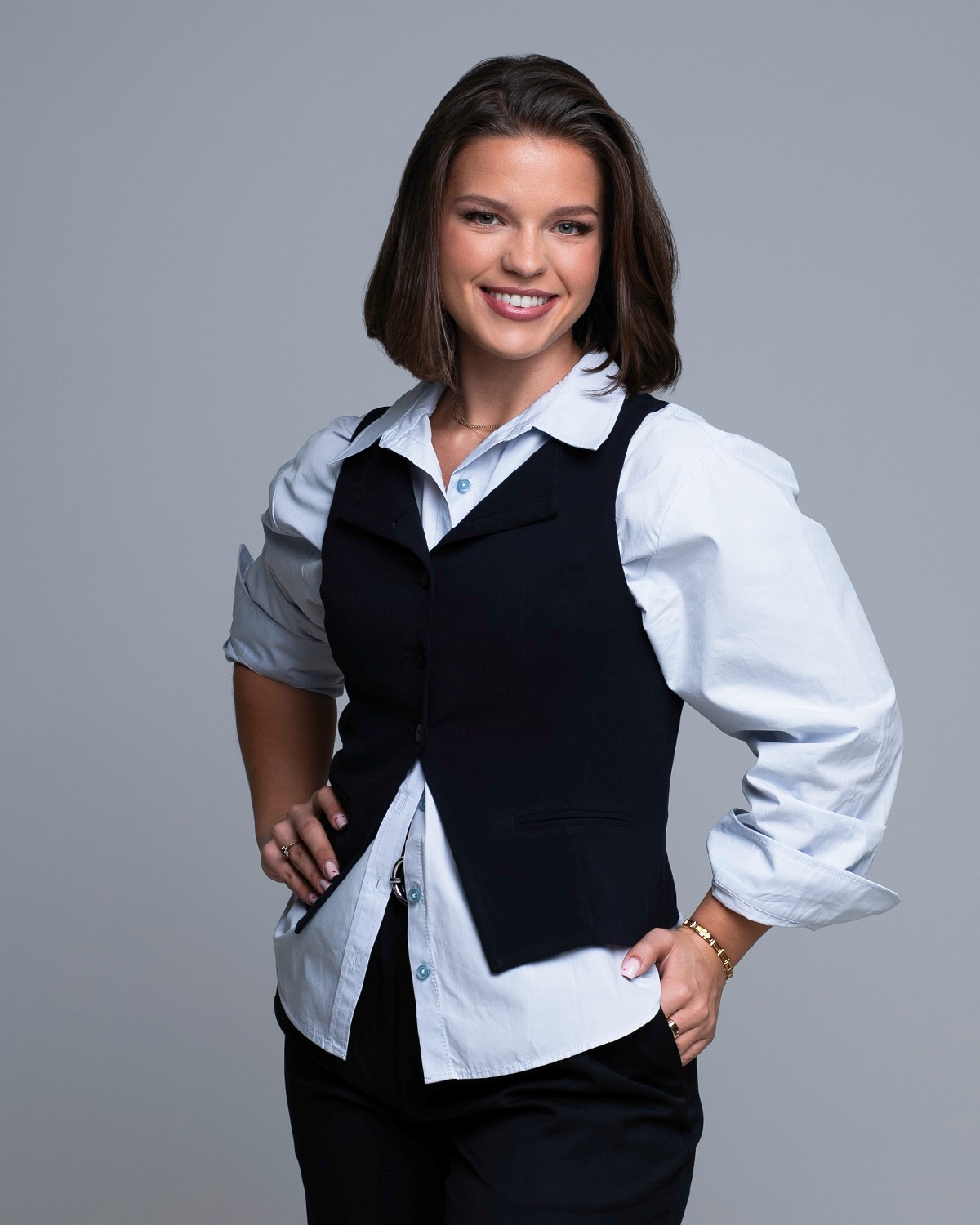
Woman in a black vest over a light blue shirt, hands on hips, gray backdrop, photographed by Annie Watson in her Naples studio
The Short Answer

A face is not flat. Your nose sits several inches closer to a camera than your ears do, and anything closer to a lens is rendered larger. When the camera is very near you, those few inches are a large share of the total distance, so the nose grows and the ears shrink away. When the camera is further back, the same few inches barely count and the face renders in normal proportion.

The lens is only involved because a wide lens forces the camera close to fill a frame with a head, and a longer lens allows it to stand back. That is why the portrait range exists: it is the range that lets a photographer be far enough away for your face to look like your face.

The lens is not doing this to you.

The usual explanation is that wide lenses distort faces. It is a convenient shorthand and it is wrong in a way that matters, because it sends people looking for the wrong solution.

Perspective is set entirely by where the camera stands. Photograph a face from six feet with a wide lens and from six feet with a long lens, then crop the wide one down to the same framing, and the two faces will be shaped identically. Nothing about the glass changed the proportions. What changes proportions is distance and only distance.

The lens becomes the culprit only because of what it makes you do. To fill a frame with a head using a wide lens you have to walk in until you are almost touching the person, and it is the walking in that reshapes the face. Change the lens without changing the distance and nothing happens at all.

This is worth holding onto because it means the fix is available to anyone, with any camera, at any moment, and it costs nothing. Step back.

The arithmetic of an arm's length.

Put actual figures on it and the whole thing becomes obvious.

Hold a camera at arm's length, roughly eighteen inches from your nose. Your ears are perhaps five inches further back, so they sit at about twenty three inches. The nose is a quarter closer to the lens than the ears are, and it is rendered accordingly larger. Your forehead, tilted toward the camera, gets the same treatment.

Now move the camera to eight feet, which is a normal working distance for a portrait. That is ninety six inches to the nose and a hundred and one to the ears. The same five inches is now roughly a twentieth of the distance instead of a quarter of it, and the difference in rendering falls away to nothing you would notice.

The features that suffer most are the ones that stick out furthest: the nose first, then the chin and the forehead when the head is tilted, then the hand if anything is resting near the face. The features that vanish are the ones furthest back, which is why ears disappear in close photographs and reappear in properly made ones.

There is no correction for this after the fact, because the camera did not record what the ears looked like from further away. It recorded them small.
The portrait range, and why it exists.

Photographers talk about the portrait range, usually meaning something around eighty five to a hundred and thirty five millimeters on a full frame camera, or the equivalent field of view on a smaller sensor. It sounds like a matter of taste and it is really a matter of geometry.

The range exists because those focal lengths let a photographer stand roughly six to ten feet away and still fill the frame with a head and shoulders. That distance is the point. The lens is the means of getting there while keeping the framing you want.

  • Around fifty millimeters you are close enough that a face begins to show it, which is why a general purpose lens can make a perfectly nice picture of a room and a slightly odd one of a person.
  • Around eighty five to a hundred and five millimeters you have the distance for correct proportion and a comfortable conversational gap, which is why so much portrait work lives here.
  • Beyond that you gain compression and lose the ability to speak normally to the person you are photographing.

Longer lenses also narrow the field of view, so much less of what is behind you appears in the frame. That is convenient in a studio, because a modest backdrop fills the picture completely, and it interacts directly with the choice of white, gray or black backdrops behind your shoulders. It also renders the background larger and softer, which people often credit to depth of field alone when distance is doing half the work.

Too far away is its own mistake.

The correction is not infinite. Keep backing up and swapping to longer glass and the effect reverses into a different kind of wrong.

From a long way off, the difference in distance between your nose and your ears becomes negligible, and the face loses the small amount of depth it should have. Features flatten out, the cheekbones stop reading as three dimensional, and the head can take on a slightly wide, pressed look. It is subtle, and it is the reason a very long lens is not simply the safest choice.

Distance also costs you the working relationship. Direction is quiet, specific and constant: chin forward and down, weight on the back foot, breathe out, look just past my shoulder. That does not survive being shouted across a room, and a portrait made without direction is a portrait of someone waiting.

So the range is a range for two reasons. Nearer than it, the geometry misbehaves. Further than it, both the face and the conversation flatten out.

The photo of yourself you already dislike.

The pictures people say they hate of themselves were usually made inside two feet, and now you know exactly what that does. A photograph taken at arm's length, a screen grab from a call, a picture someone snapped while leaning in, a passport booth: all of them are made at the one distance that reliably enlarges whatever sits at the front of your face.

There is a second reason those pictures feel wrong, and it has nothing to do with lenses. A mirror shows you a reversed version of yourself, and that reversed version is the face you know best. Every photograph shows the unreversed one, so the small asymmetries that everyone has appear on the opposite side from where you expect them. A picture can be entirely accurate and still feel unfamiliar for that reason alone.

Put the two together and a lot of self-image about photographs turns out to be a technical problem wearing a personal disguise. The face in that picture is not what you look like. It is what you look like from eighteen inches, reversed.

The practical consequence is that judging your own photogenic qualities from photographs made at close range is like judging your voice from a bad phone line. It is one of the specific things behind why professional work beats a phone photo, and it is far more responsible for the result than any specification of the device.

What to do about it, starting today.

None of this requires equipment. It requires distance and a small amount of stubbornness.

  • Stop photographing yourself at arm's length. Set the phone down further away and use the timer, or hand it to somebody and ask them to step back and then crop in.
  • If your phone has a longer setting, use it, but only if you actually move back as well. Using the longer setting from the same spot changes the framing, not the geometry.
  • For anything that matters, get the camera to at least six feet and crop afterwards. A cropped picture made from a sensible distance beats a full frame one made from close up, and modern files have plenty of room for it, which is one more reason the megapixels myth misleads people about what actually limits their pictures.
  • Watch your chin, not just the distance. Tilting the head back pushes the chin and nostrils forward toward the lens and undoes the benefit of standing further away.

Once the distance is right, the remaining variables are the ones you can genuinely control, and they are about how you sit and where you turn. That is a separate craft and it has its own guide in the angles that flatter most faces.

In a session this stops being your problem at all. The camera goes where the geometry wants it, the direction happens quietly from behind it, and the studio is arranged around that working distance. You can test it on my headshots page the way you would test any portrait: find the ears, and see whether anything is pushing forward out of the frame. What else a session decides is laid out in the guide to professional headshots.

Key Takeaways
  • Perspective is decided by how far the camera stands from you, not by which lens is on it.
  • Your nose sits several inches ahead of your ears, and at close range those inches are a large share of the total distance.
  • A wide lens only distorts a face because it forces the photographer to move in close to fill the frame.
  • The portrait range exists so a photographer can stand six to ten feet away and still frame a head and shoulders.
  • Standing much further back flattens the face and puts the photographer too far away to direct you properly.
  • The photographs you dislike of yourself were usually made at arm's length, and a mirror has also trained you on a reversed face.
Next Step

Step back, and see the difference.

Arm's length is the one distance that reliably enlarges the front of a face, and it is where most of the photographs you dislike of yourself came from. In my private Naples studio the camera sits at a working distance chosen for your face, and the direction happens from behind it. Planning and pricing are personal, so start with a quick call to (239) 319-6171 or the form.

Book a Session Call (239) 319-6171
Put It to Work

Sessions this guide points to.

Good to Know

Questions, answered.

Does a camera really add weight to a face?
Not in the way the saying suggests. What a camera does is flatten three dimensions into two and record whatever geometry it was given. A close camera enlarges the front of the face, a flat frontal light removes the shadow that would have described your jaw, and a square-on pose shows the widest version of your shoulders. Change the distance, the light and the turn and the same face renders very differently.
So is my nose actually that shape?
It is that shape from eighteen inches away, which is a viewpoint almost nobody in your life ever occupies. People see you from conversational distance, several feet back, where the proportions of your face are quite different. A portrait made at that distance is a more accurate record of how you appear to other people than a close photograph is.
What lens do you use for portraits?
I work in the standard portrait range, which puts the camera at a comfortable distance from you rather than up in your face. The specific focal length changes with the crop: a tighter head and shoulders frame wants more distance than a three quarter length one. The principle is constant, which is that the working distance is chosen first and the framing is arranged around it.
Why do I look better in photographs other people take?
Usually because they stood further away. Someone photographing you from across a table or a room is working at a distance that renders your face in ordinary proportion, and they are also unlikely to be shooting up at you from below. Both of those matter more than the camera in their hand.
Can lens distortion be corrected in editing afterwards?
Only partially, and it is a stretch of pixels rather than a recovery of information. Software can pull a face back toward normal proportion, but the detail that a distant camera would have recorded on the ears and the sides of the head was never captured, so the result softens and smears in the places it works hardest. Getting the distance right at the time costs nothing and fixes it completely.
Does the zoom on my phone solve this?
Only if you move. A longer setting used from the same place gives you a tighter crop with the identical close-up geometry, so the nose is still enlarged. The gain comes from the setting letting you stand back and still fill the frame. If you take one thing from this page, it is that your feet do more for the picture than any control on the device.
Book Your Session

Your best headshot is one session away.

Tell me a little about what you have in mind and I will be in touch personally. Pricing is personal, so the best way to plan is a quick call.

Studio
5400 Yahl St, Naples FL

Prefer to talk? Call (239) 319-6171. I respond personally.